How to Improve Local SEO: 6 Steps for Tradies

What each step does, what good looks like and where tradies go wrong.
The short version
- Two places to show up: the map, from your Google Business Profile, and your website below it.
- How Google ranks the map: relevance, distance and prominence. You can't change distance.
- Your Google Business Profile: real name and areas, a specific category, real job photos. Step 1
- Build up your reviews: ask every customer after every job, and reply to them all. Step 2
- Plan your pages: one for each service and town people search for, grouped under your home page. Step 3
- Make every page clear: its own title and heading, not the same search on every page. Step 4
- Get mentioned and linked: the same details on every listing, and links from real contacts. Step 5
- Track it and keep at it: check your rankings across your area, not just from your phone. Step 6
- Do it yourself: steps 1 and 2, and the listings in step 5, for nothing but your time.
- Hire me for the rest: a website from $5,000, then a plan from $900 a month, all + GST. How SEO for tradies works
What local SEO is
Local SEO is how you show up when someone nearby searches for what you do. For a tradie, that's the plumber, roofer or electrician search on their phone.
There are two places to show up. The map results are the businesses listed with the map, from their Google Business Profiles: three at first, the rest a tap away. The normal results are the websites listed under them.
Local SEO gets you into both, and the two feed each other: the profile sends people to your website, and I believe a good website helps the profile rank.
What decides the map results
Google's own help page names three things. The steps below work on two of them.
- Relevance
- How well your Google Business Profile matches the search.
- Distance
- How far you are from the person searching. No step changes it.
- Prominence
- How well known you are. Google gives two examples: how many websites link to your business and how many reviews you have. Steps 2 and 5 work on it.
The six steps
Steps 1, 3 and 4 build relevance, 2 and 5 prominence, and step 6 tracks it all.
- Your Google Business ProfileGets you onto the map
- Build up your reviewsHelps you rank and win the call
- Plan your pagesOne clear page per search, in groups
- Make every page clearSays what each page is about
- Get mentioned and linkedMakes you better known
- Track it and keep at itShows what's working, and where
Step 1: Your Google Business Profile
What it does: gets you into the map results. For a lot of tradies it's the cheapest place to start, so on a tight budget it comes before a website, and it's worth doing either way.
- 1The nameAs it is on your van and invoices, with nothing added
- 2The main categoryThe most specific one that says what your business is
- 3Your areasWhere you really work, address hidden if customers don't come to you
- 4PhotosYour own jobs, not just a logo
- 5ServicesEach one listed, with a short description and a price if you like
What good looks like
- The name on your van and invoices, with nothing added to it.
- Your real address, or areas only if customers don't come to you.
- The most specific category that says what your business is.
- As few extra categories as you can.
- Your services and a description, in the words your customers use.
- Photos of real jobs, which stand out from a logo on its own.
Where people go wrong
- Adding a keyword or town to the name. Google can suspend you.
- A virtual office or PO box in a better suburb. That's banned too.
- Listing towns you don't really work in, to look bigger.
- A service area over about two hours' drive from your base.
- Changing your name or address when you don't need to.
Breaks the guidelines
Smith Roofing Geelong
A town added to the name
Follows the guidelines
Smith Roofing
Just the name on the van and invoices
Change your name or address when you don't need to, and Google can make you verify the profile again to prove it's yours. That takes patience: I've waited on plenty of Google's verification postcards that turned up the day after a new one was requested.
Step 2: Build up your reviews
What it does: reviews count towards prominence, how well known you are, and they're what people read to choose between three businesses. One lower down with more good reviews can still get the call.
Two businesses, 24 reviews each in a year
SteadyEvery customer asked, after every job
Reviews each month, January to December: 2, 2, 3, 2, 2, 1, 2, 2, 3, 2, 2, 1.
BurstOne big push, then nothing
Reviews each month, January to December: 0, 0, 14, 8, 2, 0, 0, 0, 0, 0, 0, 0.
What good looks like
- A steady flow of new reviews, month after month.
- Every customer asked after every job, the same way each time.
- An easy way to leave one, sent while the job is still fresh.
- A reply to every review, good and bad, that sounds like you.
- Calm replies to bad ones, after fixing what you can.
Where people go wrong
- Offering something in return. Google's review policy bans it.
- Only asking happy customers, which is banned too.
- Arguing with bad reviews. Everyone reads your reply.
- Asking once and stopping, so your newest review gets old.
Step 3: Plan your pages
What it does: gives Google one clear page for each search worth having, grouped so it can see everything you do, with your main search on the home page and the rest under it. Here's how that looks for Ascent Garage Doors, a client of mine.
Google Business Profile 1
Main category: Garage door supplier
Website link: the home page
Home page
garage doors geelongLinks to all service and town pages
Services 2
- New garage door installationgarage door installation geelong
- Garage door repairsgarage door repairs geelong
- Garage door servicinggarage door service geelong
Areas 3
- Torquaygarage doors torquay
- Colacgarage doors colac
Guides 4
- New garage door costsLinks to the installation page
- Garage door won't openLinks to the repairs page
- Noisy garage doorLinks to the servicing page
- 1The profile points homeIts main category is the closest Google offers, and its link goes to the home page, the page for the main search.
- 2A page only if people searchEach service enough people search for gets its own page, and smaller jobs become a section on a bigger page.
- 3Areas only if people searchEach town where people search and the business really works gets a page, linked from the home page.
- 4Guides feed the servicesEach answers a question people ask before they book, and links to the page that answers "can you help?"
What good looks like
- A page for each service enough people search for.
- Smaller jobs covered as a section on a bigger page.
- Location pages only where people search and you really work.
- Guides that answer what people ask before they book.
- Each guide linking to the service page it's about.
- Links within each group and up to the home page.
- Clear link words. They matter more than most people think.
- One website for your business, not one per town or service.
Where people go wrong
- One page listing everything, matching no search well.
- A page for every small job that nobody searches for.
- Pages with little on them water the site down and need upkeep.
- A "garage doors geelong" page, when that's the home page's job.
- Cutting service words from the home page so service pages rank.
Sometimes Google ranks your home page for a service search instead of the service page built for it. On two sites I look after, better service pages and fewer service words on the home page didn't change that. What's left to try is links to the service page, from your own pages and other sites.
Step 4: Make every page clear
What it does: tells Google and the reader exactly what each page is about, so it shows up for the right search, and the person who lands on it is ready to pick up the phone.
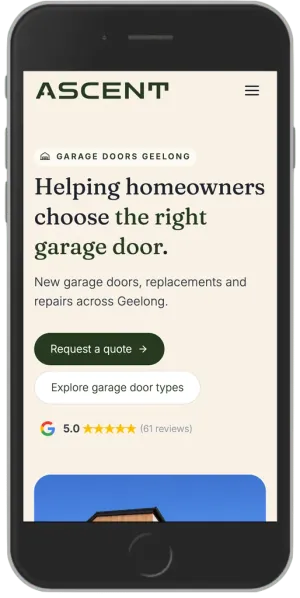
The home page
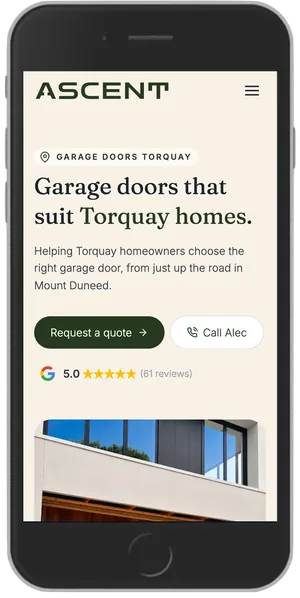
The Torquay page
What good looks like
- Each page with its own title in Google and its own main heading.
- Both in your customers' words, like the Torquay page above.
- Your town in the title, and in the text where it reads naturally.
- Business details that match your Google Business Profile.
- Structured data: code that spells your details out for Google.
- A page that loads fast on a phone, with a number people can tap.
- Words that read naturally, with anything odd rewritten.
- A page description for people. Google sometimes shows it.
Where people go wrong
- The same town and search in every page's title and heading.
- Stuffing keywords in. You're always better off under-doing it.
- Fifty near-identical suburb pages. That can be doorway abuse.
The same town and search in every title makes your pages compete, one of the biggest mistakes I see. Do it on many near-identical suburb pages and it can be doorway abuse, Google's name for pages made just to rank for similar searches, which can drop a site lower in Google, or out of it.
Step 5: Get mentioned and linked
What it does: builds prominence. Google says how many websites link to your business is part of how well known it is, and every listing is one more place where people can find you.
- Google Business ProfileSmith Roofing04xx xxx 123Matches
- Your websiteSmith Roofing04xx xxx 123Matches
- Apple MapsSmith Roofing04xx xxx 123Matches
- Yellow PagesSmith Roofing04xx xxx 123Matches
- An old directorySmith Roofing Pty Ltd04xx xxx 987Doesn't match
What good looks like
- Listings on Apple Maps, Bing Places, Yellow Pages and similar.
- The same details on all of them.
- Links from builders and suppliers who know your work.
- A link from your trade association.
- Something worth linking to, like a guide people want to share.
Where people go wrong
- Old details left on old listings.
- Mixed details: Google might think it's another business.
- Buying cheap links in bulk, which breaks Google's spam rules.
- Paying sites like hipages for leads instead of building your own.
Many directory links carry a "nofollow" tag, which tells Google the directory isn't vouching for your site, so on their own they may count for little. They're still worth having for the consistency, and for the people who find you there.
Step 6: Track it and keep at it
What it does: shows you what's working, so your time goes where it pays. Your competitors keep working on their rankings, so local SEO is never a one and done kind of job.
Ascent in Google's map results
garage doors geelong
31 of 81 points in the top 3
- Each number is Ascent's place in the map list there
- In the top 3 of the map list
- 4th or lower, a tap away
- The middle point, between Geelong and Torquay
Points 3 km apart, about 24 km across, from Geelong to Torquay, north at the top. My local rank check, 28 October 2026. The grid is one search across the area. Checked from Torquay the same day, Ascent was in the map top 3 for 10 of the 32 searches I track.
What good looks like
- Rankings checked at points across your area, like the grid.
- Checks in Google Search Console, Google's free search report.
- Searches you already show up for, found in that report.
- Calls and enquiries counted, not just website visits.
Where people go wrong
- Googling yourself at home and trusting what you see.
- Counting website visits instead of calls and enquiries.
- Setting and forgetting it. A good spot slips once you stop.
Your own searches mislead you, because results depend on where you are and what you've searched. On the grid above, one search puts Ascent anywhere from 2nd to 8th in the map list. And a website visit only pays if they get in touch, so count the calls and enquiries.
What local SEO costs
You can do steps 1 and 2 yourself, and the listings in step 5, for nothing but your time. They're worth doing whether or not you hire anyone. The rest is where most tradies get help, and it's monthly work because it never really stops. Before you sign up for a cheap package, ask what you get each month beyond a report.
| Step | Do it yourself? |
|---|---|
| 1. Your Google Business ProfileA few evenings, and worth doing either way | Yes |
| 2. Build up your reviewsAsk after every job, and reply to them all | Yes |
| 3. Plan your pagesWorking out the pages, then reworking the site | Usually not |
| 4. Make every page clearTitles, headings, structured data and speed | Usually not |
| 5. Get mentioned and linkedListings, yes. Links take time and contacts | Partly |
| 6. Track it and keep at itIt takes rank tracking tools and time every month | Usually not |
I don't sell SEO on its own. A lot of SEO is in how the pages are built, so I start with the build rather than charge you for work I'd have to redo later. That's a website built for search, from $5,000 + GST. Then my monthly plans cover the SEO, the site and your Google Business Profile, from $900 a month + GST.
How long it takes
It depends on where you start, how many tradies you're up against and how much is wrong now. A business whose Google Business Profile has one fixable problem can move faster than a new one in a crowded trade in a capital city.
Anyone who promises you a ranking or a date is guessing, and I can't promise one either. What I can do is show you where you rank now, across the area you work in, and track it every month so you can see what changes.
How to spot good local SEO
Whether you hire me or someone else, here's what I'd look for.
| A warning sign | A good sign |
|---|---|
| Only shows a ranking from their office | Shows your rank across your area |
| Holds your Google Business Profile or domain in their name | Keeps your Google Business Profile and domain in your name |
| Locks your SEO in for 12 months | Month to month, so you stay for the results, not a contract |
| Reports traffic and rankings only | Reports calls and enquiries |
| Guarantees page one or the top spot | Never promises a position |
| Shows no names and no numbers | Shows real jobs, with numbers you can check for yourself |
How I do it: SEO for tradies.
Local SEO questions
Do I need a website if I have a Google Business Profile?
You can get calls from a Google Business Profile alone, and if money is tight it's the place to start. A website backs the profile up, though, and it's where people go to check you out before they pick up the phone and call.
Can I rank in a town where I don't have an address?
On the map it's harder, because distance is one of the three things Google weighs, and a service area doesn't move you any closer to searchers. In the normal results, yes, with a good page for that area and real work there to show.
Is local SEO worth it for a small trade business?
Usually, yes. People search for a tradie when they need one now, so a top 3 spot puts you in front of them at the right moment. The basics cost little, and the rest is worth paying for once you have a crew to keep busy.
Can you guarantee me the top spot on Google?
No, and be wary of anyone who does, because nobody controls Google's results. What I can do is fix what's holding you back, and show you every month where you rank now and where your enquiries are coming from.

Written by Max Jacobs
I'm a civil engineer turned web designer, based in Geelong, VIC. I've built websites and run marketing since 2015, and I don't hand the work to juniors: the person you email does it.
Want me to do your local SEO?
I take on tradies Australia-wide, starting with a website built for search. I'll say what I'd do first and what it costs.
Start your enquiryOne tradie per trade per area for marketing, so get in before yours is taken.